ΟΊ ΣΥΖΗΤΉΣΕΙΣ
IN CONVERSATION
Alongside the reading research, the conversations/interviews have formed the largest component of this research project to date.
The conversations I have had with the practitioners have been rich, personal, complex and raw. I have only included the segments that have been approved by the participants.
In these pages, I have only captured the communications that were spoken. The other forms, those that were non-verbal, were all very present, but not fully recorded here in all their layers and richness.
The p a u s e s, the shifts in the chair, the held gazes, the looks away.
The speeding-up-of-the-phrases, or the weighted s l o w i n g d o w n. The giggles, the furrowed brows, the sighs, the sudden laughs, the tight fists.
All this ephemeral data, all present in the room, alongside all the spoken words.
Naturally, I was not an impartial, neutral presence in each conversation. I, the researcher (or more accurately in these scenarios, the facilitator) also arrived with my own set of beliefs, emotional states, aims and biases. Being so, I am choosing to call these conversations, rather than interviews. If this research is about making space for ‘all our selves to enter the room’, then I must equally acknowledge that I am also bringing all of mine.
My aims – re-evaluated:
The following questions were at the fore of my thinking in every conversation and workshop –
How can we examine where movement originates from when we approach new choreographies?
How can we fold in movement qualities, structures, and narratives that feel culturally located?
How can we re-claim movement qualities that may have been subsummed, ignored or replaced?
Initially, I had intended to book studios and start to explore movement rather quickly, perhaps after one or two initial conversations about the research. I had hoped to allow the body its own agency. Instead, we spent a lot of our time together listening. Me, listening. To the descriptions of the many and complex feelings held in the body. To the feelings about what is ‘permitted’, given space and prominence, and what is not. What is locked away, shunned, dis-approved of. For many, dancing was the first way they had connected with their creativity, their essence, their sense of self. Yet, after years of training, often within disciplines or cultures vastly different to their own, the unique movement identity that they had started with was concealed, re-placed or disguised. What seemed to be bubbling up for many of the participants now, in these conversations, was a sense of longing - a longing and a desire to reclaim something that had been lost, abandoned, ignored, rejected, masked, or flattened out within their dance practice and careers.
What these interviews became were spaces for knowledge and experience exchange. Testimonials, both corporeal and psychic. Non hierarchical spaces, where we opened up a place for discovery, of the un-known and the yet to be known.
I am incredibly grateful for the honesty, curiosity, courage and compassion of all the participants.
ΑΠΟΣΠΆΣΜΑΤΑ
EXTRACTS

IT IS IN OUR CULTURAL DNA,
IT IS A CULTURAL PASSING-ON”
“
[A] Dr. Chris Jannides (Greek/New Zealander)
Choreographer and Dance Scholar
8th Febuary 2026
We meet online. I speak from Wellington, Chris from a small town in Australia. It is raining where I am. A clear blue-green light typical of Aotearoa. Chris is surrounded by a very different light; yellows, golds.
I can sense the heat. Chris speaks slowly. He is very considered. He is weighing the words, checking the weight and shape of them.
I ask him how he has been. What does he do with his days?
He tells me he is working with clay. Learning pottery.
And that he has started to learn more Greek folk dances.
I ask him about his journey into dance.
He answers:
For us, growing up Greek, it is what we all did. How we’d come together. Breathing together, moving together - in circles.
I ask how he found his way into contemporary dance:
For me, dance is what the [Greek] men were doing. But I couldn't see that amongst the Kiwi blokes. Contemporary [dance] was a way back to movement. It was natural. But I had to find it in New Zealand. It wasn’t everywhere, like it is in Greek culture.
I tell Chris of my increasing interest in folk dance as a cultural signifier and unifier. I ask him what he thinks of that.
He says:
Well, it is in our cultural DNA, it is a cultural ‘passing-on’. There is a particular rhythm with each folk dance. It reflects the work of the people. Working the land together. Cultivating. For us Mediterraneans, cultivation of that land has been happening for a long time.
I point out that he is working with clay now. How full circle his DNA has come. He laughs. A low, internal laugh. We talk of the impermanence of the material: Clay. That will in time, become earth again.
(Typing up this conversation, I find a reflection written in the margins of the transcription, ‘His entire choreographic praxis distilled into his hands, into the clay. Movement manifest into solid form. Back to the earth.’)

WHO COULD UNDERSTAND THE CULTURAL AND PERSONAL QUESTIONS I WAS CARRYING THROUGH MY DANCE-BODY”
“
[B] Veronica Lyu (Chinese)
Dancer and Choreographer
10th April 2026
We meet online. Until very recently Veronica was a company dancer for Footnote NZ Dance, based in Wellington/Te Whanganui-a-Tara. She is now living in Auckland/Tāmaki Makaurau.
She speaks to me from her deck. The laptop on the ground in front of her. She folds her body over to be closer to the screen. She has a liquid quality in her movements. She is very warm. Very open. I barely ask any questions. I let her speak.
I felt so alone when I started studying dance in New Zealand. I had to find my own way. My own language.
Coming out of a company setting, after many years, how could I describe myself as a dancer? What did my movement look like?
I kept returning to my beginnings of Classical Ballet, and traditional Chinese dance. Both highly disciplined. Finding the connections between the two. The links within my body.
Simple gestures in Classical Chinese dance always bring me back to a young me. They become links to home. The breathing! The breathing is an important part ! Each movement is influenced differently by different breathing.
There are 56 major cultures in China - all are learnt and they combine within us. I have spent a lot of my time understanding how to breathe differently with each style. It influences how you move, the delivery.
It is the beginning of everything.
The stories, the spirits embedded in the histories of folk tales. Minute movements that restrain or conceal - they all tell different stories.
12 June 2026
I found it very difficult finding a mentor in New Zealand. I didn’t feel reflected by anyone in the contemporary dance world. There was no reflection. There is a loneliness in that.
How do you find the person that reflects you?
[Practicing in New Zealand] meant I had to learn what the new parameters, boundaries were.
I often feel both in and outside of myself. What do others see? What are the stereo-types of a Chinese female artist? When I signed up to agencies, I had to consider what kind of categories I would fit into?
I am attracted to the challenge of that. How I am seen. Who I am.
New Zealand is a very different country [to China]. It is a soft bubble.
It has been difficult finding home here.
I don’t dance much when I'm back in China. I’m not a ‘dancer’ in China. To tell you the truth, there are no ‘sparks’ for me in China - because it feels safe. That is where my family and home are. My dance-language comes from Aotearoa. What audiences are interested in, in Aotearoa, determines what we present. I learnt to be an artist in New Zealand. How to make artistic choices. I am very aware of mis-representation and stereotyping, especially in the company [setting]. There is a tradition/contemporary gap in migrant families that I am very aware of.
Veronica’s additional thoughts via email:
I was not only looking for professional guidance, but also for someone who could understand the cultural and personal questions I was carrying through my dance-body and practice. In many ways, that lack of connection has shaped me and made me more aware of the importance of mentorship that feels culturally responsive, relational, and genuinely reflective of different lived experiences. It has helped me constantly reflect on my own movement journey, become more independent and think about the kind of mentorship I hope to offer to the next generation of artists one day.
Image credit: 'Dry Spell' by Rose Philpott, for Footnote NZ Dance.
Photo by Kerrin Burns 2023

WHO COULD UNDERSTAND THE CULTURAL AND PERSONAL QUESTIONS I WAS CARRYING THROUGH MY DANCE-BODY”
“
[C] Tānemahuta Grey (Māori - Ngāi Tahu, Rangitāne, Waikato (whāngai) Choreographer and Artistic Director
27th April 2026
Tānemahuta and I discussed the deep entwinement between the spiritual and the creative in Te Ao Māori [Māori world view], and how much this resonates into non-maori practice in Aotearoa.
Dance, creativity for many Māori is a spiritual portal. An entry point into spiritual being. It is vital to have an anchor point. You can go in, but have to have the ability to come back out.
For Māori, creativity is a deeply spiritual act. We are connecting with our ancestors, they are leading us.
We have a duty to be careful when we bring them into the room.
Keep the space spiritually clean. The need for pōraki, which is the
‘wrap-up’, acknowledging everything that has occurred in the room,
and where we are as we leave it. This can take the form of a kōrero [conversation with everyone in the space]. We must be responsible for what we have transformed the room into.
And so, we end with a karakia [a prayer], and we close the ‘corridor’ down, so that we may continue with our day.
Image credit: Phillip Merry for Taki Rua Productions
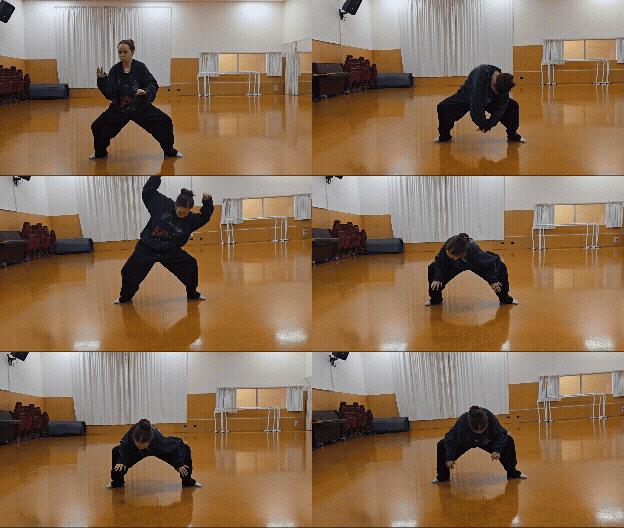
I AM THIS!”
“
[D] Kōwhai Deuchars (Māori/Scottish)
Hip Hop dancer, company dancer of Shifting Centre.
26th May, 2026
[I danced] Ballet and Jazz when I was little, but it just wouldn’t scratch the itch. I danced Jazz for ten years. Before that I would dance around the house, make up my own dances.
When I was nine years old, I discovered Hip Hop, and this dance felt like my identity. I competed until I was 18 years old. My whole community came through dance. I used to be a dance teacher full time for ten years, but it was just Hip Hop.
(I asked why Kōwhai said ‘just Hip Hop’, and she laughed, threw her head back, then covered her face for a moment.)
I now dance with the dance collective Shifting Centre (a Māori/Pasifika Dance Collective, named after the Toni Morrison quote). There are 6–10 of us in the company. We are [guided by] the director has the vision, but we all work together, work to each other’s strengths. We don’t impose or enforce movement.
Depending [on the work], there are different levels of leadership.
My partner is in the company too. He is Māori/Greek. The parents on both sides of us were disconnected, separated from Māori culture. Dance] has been the journey into discovering my cultural identity. Kapa Haka was always really strong for me. Especially through Clyde Quay [Primary School]. We all bonded because of Kapa Haka.
I realised oh, I am this!

I HAVE TO FOREVER OTHER MYSELF, IN ORDER TO HAVE A PLACE WITHIN”
“
[E] Dijbril Sall (Senegalese)
Choreography, Dancer and Teacher
12th June 2026
We meet for the first time outside a cafe in Wellington
Te Whanaganui-a-Tara. It is bright and chilly.
Dijbril talks of his practice as a ‘practice of locality’, as he identifies with so many places simultaneously. He was born in Senegal, raised in various cities in The United States, lived in Paris, and has now settled in Berlin.
He discusses the problem of having to identify as one thing, of the pressure to champion the causes of only one aspect of your identity, that in turn can then overshadow and subsume all the others. He questions how he can ‘represent a Senegalese ideal, when that ideal can feel dangerous to me’. Dijbril is queer, and is not a practicing Muslim, as is the rest of his family. His family lineage comes from an ethnic group in Senegal which converted to Islam as early as c.900 CE. He talks of this rupture, this severance from a strong family structure.
He says, ‘I am an exile. For reasons I cannot control. How can I talk about all this, when talking about myself? This is what my [dance] practice is
Dijbril discusses the problems of identity politics and funding proposals, and thus the opportunities to present work: Sometimes funding proposals feel like colonial anthropological specimen cabinets.’ He discusses the ‘containing and reductionist approach to having to define oneself in a very particular way, as desired by the funding bodies, in order to make work. I have to take an alienated standpoint where I have to forever ‘other’ myself, in order to have a place ‘within’.

WE MUST BREAK THROUGH THE BARRIERS, BREAK THROUGH THE FATIGUE, MAKE NEW SHAPES OF RESILIENCE AND DISCOVERY”
“
[F] Tiaki Kerei (Māori -Ngāti Porou, Ngāti Kahungunu, Ngāpuhi,
Te Rarawa) Artistic Director of Whakamana Creatives
There are certain words that keep coming up in this conversation:
To Un-shackle. To enable. The scaffolding. To acknowledge.
A teacher must prepare the scaffold which acknowledges the different spaces. We must acknowledge loss. It is the whole part of the cycle! We are equally entitled to occupy all parts of that continuum.
We must remember to be the student.
Dancing is an internalised need. A reflection. It is hard work; physically, mentally, spiritually, artistically. It is the whole gamut.
My initial love of dance came from tertiary education/level. It was Life-force manifest. A joyful overloading of all the senses.
A constant act of interpreting, re-interpreting, contemplating, re-visiting all the injuries. All of them! The ones of my body, and the ones of my culture. Dance is the whakapapa of the body. We exist in relation to the body.
My entry into dance? I was responding to the demands of the teachers.
I benefited from the replication etc, I questioned those demands. I also questioned, what was not being cultivated emotionally?
So - I'm often brought into institutions to discuss indigenous dance practice. We are a shared vessel, a shared whakapapa. How do we hold that space? How do we ‘co-habitate’?
It is very important, becoming increasingly important to me, to create a ‘standing-place’, a turanganwaewae. We must be able to access all the different parts of our psyche. I’m especially mindful of this when creating within an institution. I tell people, ‘this dance is about YOU!’ all parts of you.
No one can give you the ‘keys’ to re-claim, re-store, be with it. We have to search for it ourselves. I saw it as something outside of the self. I was in search of my own whakapapa.
Energetically we ARE.
I cried for a year when I started to re-connect with my mum’s whenua [land]. Sitting on the red leather couch, and listening, allowing… I felt like I had deeply missed out on something. I come from a lineage of healers and shapeshifters. I had to learn to layer in the filter of spiritual potential. And, like getting laser surgery on my eyes, I felt like I could see clearly. Experience clearly.
The language of my region is not spoken anymore, because of the standardisation of Te Reo. We could no longer translate the original manuscripts of my people. It was all encrypted through poetry, metaphor, analogy.
I started Atamira because I felt I would not survive this industry, if my body and my psyche are not treated in a certain way. What spurned me on was a sense of survival. Improvement of us all, has to take place in a more universal space. It must be cross-human, cross-cultural.
I wanted to open a space, then can then be opened further.
Yes, re-indigenise our practice. We must acknowledge the source of our being. This is WHO I AM.
I am very focused on the relationships in the room. The importance of relationships. What is the best way to make the connection? How are we holding the space? How are we spiritually responsible? How can we be in unison ? This is a key attribute in te ao māori. That one-ness that takes us all to a different level, together. We must practice manaakitanga from the beginning. This is deep research, the mahi the work. Any outcome is just that, an outcome, dependent on the foundations.
There is a shared responsibility of living together in these lands. We are representatives of our ancestors.
We must navigate the different and at times conflicting ideas of time [more chronos, than ora]; the institutional, the ancestral, the indigenous, the societal.
We must break through the barriers, break through the fatigue, make new shapes of resilience and discovery. Be mana whenua to yourself!
Image credit: Jinki Cambronero,2026. Art Day for Gender Equality